Walmart Seller Central vs. Retail Link: The Enterprise Brand's Guide to 1P, 3P, and When to Run Both

Quick answer: For most enterprise brands in 2026, Walmart Seller Central (3P) is the default — it gives you pricing control, content ownership, and access to Walmart Connect PPC. Retail Link (1P) works when Walmart approaches you with a purchase order commitment and your SKUs are high-velocity enough to justify thin wholesale margins. Hybrid is the right architecture for complex catalogs, but only when it's deliberate.
Most enterprise brands that come to us with a Walmart problem have already made the structural decision — 1P or 3P — without fully understanding what they gave up.
Retail Link feels safe because Walmart is the buyer. Seller Central feels risky because you own the operations. Neither instinct is wrong, but neither is sufficient for a brand doing serious volume on the platform. The real issue is that this decision gets made at onboarding — usually based on a broker recommendation or a Walmart rep's suggestion — and then it compounds quietly for years while the brand wonders why its Walmart program isn't performing the way it should.
The 1P vs. 3P choice is not a setup question. It's a margin, control, and strategic-positioning decision that shapes everything downstream.
The Decision Most Brands Get Wrong Before They Even List

Here's the tell: when we audit brands new to our portfolio, one of the most common gaps we find is a brand running both a 1P item setup and a 3P listing for the same SKU — not as a deliberate hybrid strategy, but because a merchant relationship and a marketplace listing coexisted without anyone coordinating them. Two listings, competing against each other, with no intentional logic behind either.
That's not a Walmart problem. That's a structural decision that was never actually made.
The default path for most enterprise brands is whichever model their retail broker or Walmart rep recommended at onboarding. Brokers have relationships with Walmart's merchant team and naturally steer clients toward 1P. Marketplace reps push Seller Central. Neither recommendation is made with your P&L in mind — it's made with the path of least resistance in mind.
The structural difference is worth stating plainly. In 1P (Retail Link / Supplier), Walmart buys your inventory at a negotiated wholesale price and resells it. You are a vendor. Walmart sets the retail price, controls most of the content on the item page, and manages the customer relationship. In 3P (Seller Central / Marketplace), you list your products directly on Walmart.com, set your own prices, fulfill via WFS or your own 3PL, and sell directly to Walmart shoppers. You are a seller.
That distinction — vendor vs. seller — is not semantic. It determines who controls the margin, who controls the listing, who controls the promotional calendar, and who has access to Walmart's ad stack.
The argument of this post: 3P via Walmart Seller Central is the right default for most enterprise brands in 2026. But 1P has specific scenarios where it wins, and hybrid is often the right answer for brands with complex catalogs. The key is making the decision deliberately — not inheriting it.
How Walmart Seller Central (3P) Actually Works
Walmart Seller Central is the operational dashboard for third-party marketplace sellers. Item setup, inventory management, order management, Walmart Connect PPC, and analytics all live here. You list your products on Walmart.com, set your retail prices, and fulfill either through WFS (Walmart Fulfillment Services) or your own 3PL.
The economics are straightforward: you keep the spread between your cost and the retail price, minus Walmart's referral fee. Referral fees vary by category and are publicly documented, which makes margin modeling at the SKU level clean and predictable. No annual cost negotiations, no chargeback schedules to model, no merchant relationship to manage.
Content ownership is the underrated advantage. In Seller Central, you control the title, bullets, images, rich content, and variant structure — and you can update them without waiting on a merchant or a content team at Walmart HQ. Changes go live on Walmart's standard indexing cycle. For brands that treat listing optimization as an ongoing program rather than a one-time setup, this matters enormously.
WFS is the default recommendation for most 3P sellers. The 2-day shipping badge it confers has a meaningful effect on Buy Box eligibility and conversion rate — Walmart's algorithm weights fulfillment speed heavily, and brands fulfilling from their own warehouse without a Walmart-approved 2-day carrier setup don't get the badge. WFS handles pick, pack, ship, and returns, which substantially reduces the operational burden for brands without their own fulfillment infrastructure.
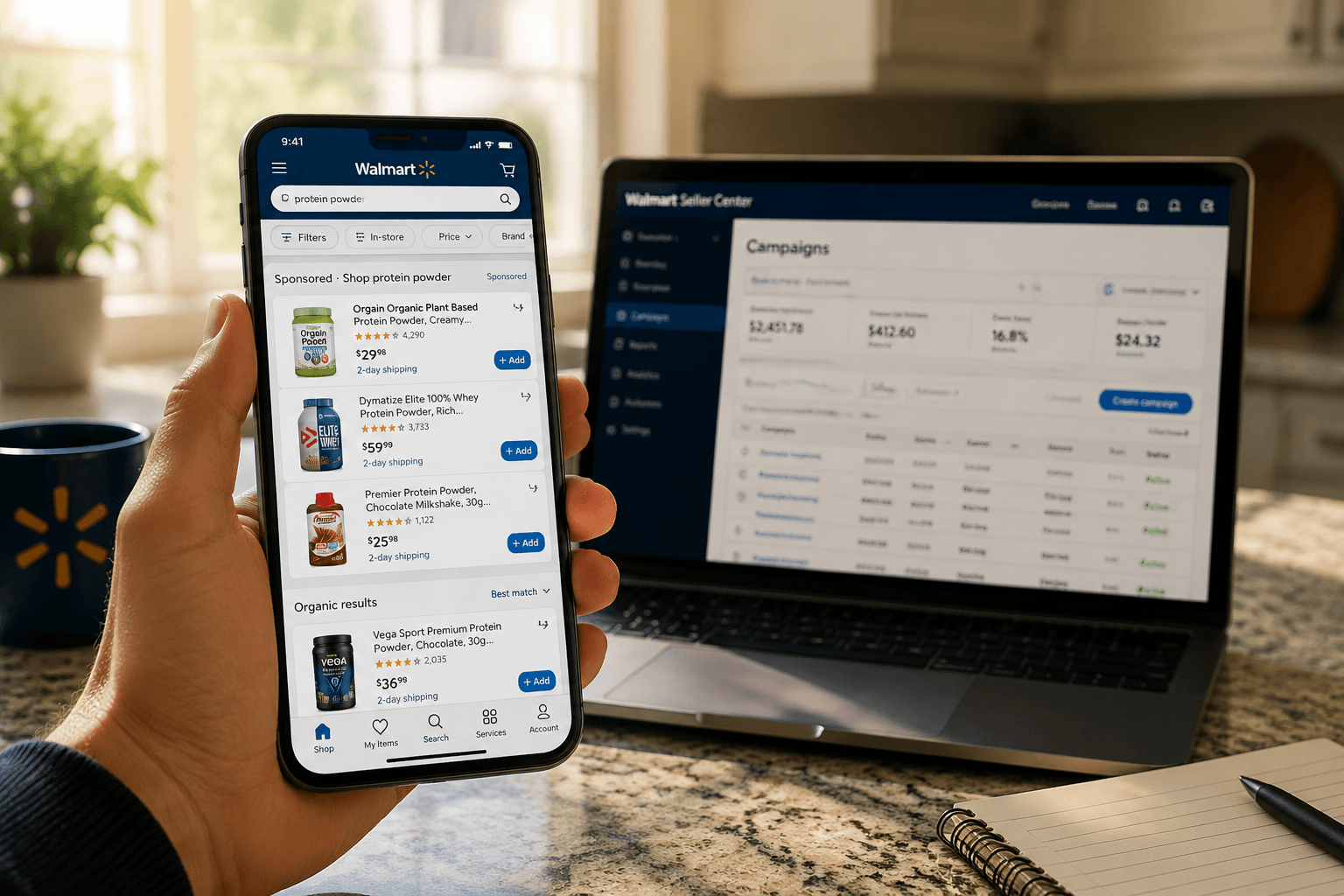
Walmart Connect PPC — Sponsored Products, Sponsored Brands, and Search Brand Amplifier — is only accessible to 3P sellers via Seller Central. This is not a minor detail. It's a structural advantage: 3P brands can drive incremental traffic and velocity on demand. 1P brands cannot self-serve on the same ad stack.
How Walmart Retail Link (1P Supplier) Actually Works
Retail Link is Walmart's supplier portal — the interface through which 1P vendors manage purchase orders, inventory replenishment data, sales reporting, and compliance scorecards. It is a genuinely powerful data system. It is also a genuinely different operational world from Seller Central.
In the 1P model, Walmart issues a purchase order at a negotiated cost price. Walmart sets the retail price, runs promotions, and controls the content on the item page. Suppliers can submit content via Item 360 or the Content Hub, but Walmart's merchant team retains override authority. Your submitted content can be changed or reverted without notice.
The margin structure is fundamentally different from 3P. You sell to Walmart at wholesale, so your margin is locked at negotiation. You don't benefit from retail price increases. You absorb chargebacks and compliance penalties that Walmart processes automatically through Retail Link — and those deductions can erode the deal materially.
Chargebacks are the hidden cost most 1P brands underestimate. Late shipments, non-compliant labeling, fill-rate misses, and EDI errors all generate automatic deductions. Brands new to Retail Link routinely see their first several quarters eroded by chargebacks they didn't model at negotiation. It's not that Walmart is punitive — it's that the compliance requirements are real and the deduction system is automated. If you're not running tight retail ops, the chargebacks will find you.
1P does carry one structural advantage worth naming: Walmart's own systems prioritize in-stock 1P items for certain placements, and the "Sold by Walmart" designation carries trust signals with some shopper segments. For high-velocity consumables where Walmart is willing to commit purchase orders at meaningful volume, the 1P model can work — the volume justifies the thin per-unit margin.
Retail Link's data infrastructure is also genuinely useful for demand planning. Weekly point-of-sale data, inventory positions, and sell-through rates are available at the store and item level. Brands that know how to use Retail Link data have a real supply chain advantage. Most brands don't use it well — they pull the reports and don't act on them systematically.
Margin Control: Where 3P Wins and Where 1P Traps You
This is where the decision has the most long-term consequences.
In 3P, you set the retail price and adjust it in real time. Promotional pricing, bundle pricing, and competitive response are all within your control and take effect within hours. If a competitor drops price, you can respond. If you want to test a higher price point on a premium SKU, you can test it. The P&L is yours to manage.
In 1P, Walmart sets the retail price and can mark it down without your consent. If Walmart drops the price to match a competitor — which it will, because Walmart's pricing algorithm is aggressive — your cost price doesn't change. Your effective margin compresses. You have no recourse until the next cost negotiation cycle.
- Who sets retail price — 3P (Seller Central): You. 1P (Retail Link): Walmart.
- Margin predictability — 3P (Seller Central): High — model at SKU level. 1P (Retail Link): Lower — subject to Walmart markdowns.
- Chargeback exposure — 3P (Seller Central): Minimal. 1P (Retail Link): Meaningful — automated deductions.
- Cost negotiation cadence — 3P (Seller Central): None — referral fee is fixed. 1P (Retail Link): Annual or at category review.
- Response to competitor pricing — 3P (Seller Central): Real-time. 1P (Retail Link): Dependent on merchant relationship.
- Best fit by SKU type — 3P (Seller Central): Premium, high-AOV, new launches. 1P (Retail Link): High-velocity consumables at scale.
The chargeback system in 1P is a structural margin leak, not a one-time risk. Across enterprise brands we've onboarded from 1P-only Walmart programs, chargeback reconciliation is the first thing we pull — it's reliably the largest unmodeled cost in the program, and it's almost always worse than the brand expected.
3P referral fees are predictable and category-specific. Model them at the SKU level before launch and the P&L is clean. No surprises mid-quarter.
For high-velocity, lower-AOV SKUs — consumables, food, health staples — the 1P wholesale model can work if the volume commitment is large enough to justify thin per-unit margin. For premium or high-AOV SKUs, 3P margin control is almost always superior. The math is simple: when Walmart can compress your retail price without warning, the SKUs with the least margin cushion get hurt the most.
Content Ownership and Listing Control: The Underrated Battleground
Content control is where the 1P vs. 3P gap shows up most clearly in day-to-day operations — and it's the dimension brands most consistently underestimate when they choose 1P.
On 3P, you own your listing. Title, bullets, images, rich content, and variant structure are yours to update via Seller Central. No merchant approval required. Changes go live on Walmart's standard indexing cycle. If you want to test a new hero image, update a title to front-load a high-intent keyword, or add a lifestyle module, you do it today.
On 1P, content submission goes through Item 360 or the Content Hub, but Walmart's merchant team retains override authority. Your submitted content can be changed or reverted without notice. Update cycles are slower than 3P self-serve. In competitive categories where listing quality is a meaningful conversion lever, that lag is a real disadvantage.
This matters for PPC in a way that brands running 1P often don't connect: a brand running Walmart Connect PPC to a listing it can't control is spending ad budget to drive traffic to a page it can't optimize. That's the same broken-loop problem we see on Amazon when sponsored ads run to unoptimized listings. The Laser Focused Blueprint sequence — SEO first, CRO second, PPC third — exists precisely because paid traffic amplifies whatever the listing is doing. If the listing is weak and you can't fix it, the ad spend works against you.
Walmart's search algorithm rewards keyword-rich, accurate, front-loaded titles. The first 50–80 characters carry disproportionate weight. In 3P, you can test and iterate on that in real time. In 1P, you're dependent on Walmart's content ops timeline — which is not built around your testing cadence.
Rich content — comparison charts, lifestyle modules, enhanced brand content — is available to both models but meaningfully easier to deploy and update in 3P. As of 2026, Walmart has expanded its rich content formats, and brands with active 3P programs can iterate on A+ equivalent modules on a cadence that 1P content workflows simply can't match. For brands running the Sightline AI Engine's weekly creative cadence — assets briefed Monday, shipped Friday — the 3P model is the only one that can absorb that velocity. Submitting new rich content through Item 360 on a weekly cycle is not realistic in practice.
Content is not a setup task. It's an ongoing competitive lever. The model that gives you control of that lever is 3P.
Promotional Flexibility: Who Controls the Lever
Promotions are where the operational difference between 1P and 3P becomes most visible — and most consequential during peak periods.
3P sellers can run Walmart-native promotions — rollbacks, clearance flags, promo price events — through Seller Central on their own timeline, subject to Walmart's promotional calendar and approval process. You initiate. You control the depth. You decide when to pull the lever.
In 1P, promotional pricing is controlled by Walmart's merchant team. Suppliers can request promotional support but cannot execute independently. If Walmart decides not to promote your item during a key seasonal window, you have no recourse. You are a passenger on a calendar that Walmart sets.
Walmart Connect PPC — Sponsored Products, Sponsored Brands, and Search Brand Amplifier — is only available to 3P sellers. Worth repeating, because brands evaluating 1P sometimes don't realize they're opting out of the ad stack entirely. In 2026, Walmart Connect is a growing and increasingly competitive platform. Brands that can't access it are ceding incremental traffic and velocity to competitors who can.
Walmart's major promotional events — Black Friday, Deals for Days, Cyber Monday — do favor 1P items in some placements because Walmart controls the pricing and can guarantee the deal depth. That's a real advantage for 1P brands with the right SKUs. But 3P brands with competitive pricing and WFS fulfillment increasingly access these placements too, and the gap has narrowed as Walmart has expanded marketplace participation in its events.
For brands running seasonal or event-driven campaigns, the inability to self-serve promotional pricing in 1P is a genuine constraint. You are dependent on a merchant relationship and a calendar that Walmart sets. If the merchant relationship is strong and the timing aligns, it works. If either condition fails, you miss the window.
3P gives you the ad stack and pricing control. 1P gives you potential access to Walmart-curated event placements, but you're dependent on timing and depth you don't control.
The Hybrid Model: When Running Both 1P and 3P Is the Right Answer

Hybrid is not a hedge. It's a deliberate catalog architecture decision.
The most common hybrid pattern we see across enterprise brands: core high-velocity SKUs in 1P, where Walmart buys them, manages replenishment, and they appear as "Sold by Walmart" — while newer launches, premium SKUs, or limited-edition items run in 3P where the brand controls content and pricing. The 1P items are proven, high-volume, thin-margin workhorses. The 3P items are where the brand is building velocity and protecting margin.
Another hybrid use case: a brand with an existing 1P relationship that is expanding its catalog. New items launch in 3P to prove velocity and margin before offering them to Walmart's merchant team for 1P consideration. This is a smart sequencing move — you're not asking Walmart to take on inventory risk for an unproven item. You prove the demand in 3P, then negotiate from a position of data.
The operational risk of hybrid is real and specific: the same SKU appearing in both 1P and 3P creates a Buy Box conflict and can suppress both listings. This requires deliberate SKU segmentation — not the same item in both models simultaneously. If you're running hybrid and haven't explicitly mapped which SKUs live where, you almost certainly have overlap you're not aware of.
Hybrid also complicates attribution and reporting. Retail Link data and Seller Central analytics are separate systems with different metrics and attribution logic. Brands running hybrid need a consolidated view, or they will misread performance — crediting 1P for volume that 3P drove, or vice versa.
In our experience managing both 1P and 3P Walmart programs across enterprise brands, the hybrid model works best when there is a clear SKU-level decision framework and a single team accountable for both systems. When the 1P relationship is managed by a retail ops team and the 3P program is managed by an ecommerce team with no shared reporting, the programs drift.
Unintentional hybrid is one of the most common Walmart problems we inherit. It's almost always worse than either model run cleanly.
- First-time Walmart launch — Recommended Model: 3P (Seller Central). Reason: Lower friction, full content control, PPC access.
- High-velocity consumables, large PO commitment — Recommended Model: 1P (Retail Link). Reason: Volume justifies wholesale margin.
- Premium or high-AOV SKUs — Recommended Model: 3P. Reason: Margin compression risk too high in 1P.
- New catalog expansion from existing 1P base — Recommended Model: Hybrid (new items in 3P). Reason: Prove velocity before 1P negotiation.
- Large catalog with distinct SKU tiers — Recommended Model: Hybrid. Reason: Match model to SKU economics.
- Brand requiring Walmart Connect PPC — Recommended Model: 3P required. Reason: PPC not available to 1P sellers.
- Brand with 'Sold by Walmart' trust requirement — Recommended Model: 1P or Hybrid. Reason: 1P confers that designation.
Operational Complexity: What Each Model Actually Demands From Your Team
The operational load of each model is different in kind, not just in degree.
3P via Seller Central requires active operations: item setup, inventory management, WFS replenishment, order defect rate monitoring, returns management, and ongoing PPC management. It is more work than handing inventory to Walmart and waiting for a purchase order. But the levers are yours — and the consequences of operational gaps (low inventory, high order defect rate, slow shipping) are visible in your own dashboard, not buried in a chargeback report you get 60 days later.
1P via Retail Link requires EDI compliance, fill-rate management, chargeback reconciliation, and a working relationship with a Walmart merchant. It's a different kind of operational load — one that punishes brands without dedicated retail ops resources. The compliance requirements are not optional and not forgiving. Brands that treat 1P like a passive revenue stream get hit with deductions they didn't budget for.
WFS substantially reduces the 3P operational burden for brands without their own fulfillment infrastructure. It handles pick, pack, ship, and returns. The 2-day badge it confers is not available to brands fulfilling from their own warehouse without a Walmart-approved 2-day carrier setup — so for most brands without existing fast-fulfillment infrastructure, WFS is the practical path to the badge, not an optional upgrade.
Retail Link's data infrastructure is worth using even if you're primarily a 3P seller with some 1P exposure. Weekly point-of-sale data, inventory positions, and sell-through rates at the store and item level are available in a way that Seller Central analytics don't replicate. Brands that build a systematic workflow around Retail Link data have a supply chain advantage in demand planning. The problem is that most brands pull the reports and don't act on them — the data sits in a spreadsheet and doesn't change replenishment decisions.
For brands without a dedicated Walmart ops function, 3P is the lower-friction entry point. For brands with an established retail ops team and existing Walmart merchant relationships, 1P or hybrid may be more natural. The agency or internal team managing the program needs to be fluent in both systems if hybrid is in play — Retail Link and Seller Central are not interchangeable, and the operational logic of each is distinct.
Which Model Fits Your Brand — The Decision Framework
Default to 3P (Walmart Seller Central) if:
- You are launching on Walmart for the first time and want the lowest-friction path to a live, optimized listing
- You want to run Walmart Connect PPC — Sponsored Products, Sponsored Brands, or Search Brand Amplifier
- Your catalog includes premium or high-AOV SKUs where margin compression is unacceptable
- You have a content program you want to control and iterate on
- You plan to use WFS and want the 2-day fulfillment badge
Consider 1P (Retail Link) if:
- Walmart has approached you with a merchant relationship and a meaningful purchase order commitment
- Your SKUs are high-velocity consumables where volume at scale justifies thin wholesale margin
- Your brand's retail strategy requires the "Sold by Walmart" designation in specific categories
- You have a retail ops team equipped to manage EDI compliance and chargeback reconciliation
Run hybrid if:
- You have a large catalog with distinct SKU tiers that map cleanly to different margin and velocity profiles
- You are using 3P to prove new items before offering them to Walmart's merchant team for 1P consideration
- You have an existing 1P relationship you cannot exit but want to expand into categories the merchant team won't take on
The questions to answer before deciding:
- Can you model the 1P chargeback exposure accurately, including the first several quarters of compliance learning curve?
- Do you have the content ops bandwidth to manage Retail Link submission cycles — or do you need the real-time control of Seller Central?
- Is Walmart Connect PPC part of your growth plan? If yes, 3P is required.
- Do you have WFS-ready inventory or a 2-day fulfillment alternative?
- If hybrid, do you have a clear SKU-level segmentation map — or are you at risk of the same item appearing in both models?
As of 2026, the brands gaining the most ground on Walmart are running 3P with WFS, active Walmart Connect PPC, and a content program they control. They're not waiting on a merchant relationship to move their catalog. They're building velocity in Seller Central, iterating on listings, and using the ad stack to accelerate what's already working.
If you're unsure which model your current Walmart setup is actually running — or if you suspect you have an unintentional hybrid situation — that's the first thing to audit.
The structural decision should be deliberate, not inherited.
The Content Angle Most Brands Miss in Either Model
One thing that cuts across both 1P and 3P: listing quality is table stakes, not a growth lever. The brands winning on Walmart in 2026 treat content as an ongoing competitive program, not a one-time setup task.
In 3P, you have the control to run that program. In 1P, you're constrained by Walmart's content ops timeline. But in either model, the quality of what you submit matters — and most brands are submitting content that was built for Amazon, not for Walmart's algorithm or Walmart's shopper.
Walmart SEO is not Amazon SEO. The algorithm matches on literal, front-loaded keywords. The first 50–80 characters of the title carry disproportionate weight. Backend keyword fields don't exist the way they do on Amazon. Bullet points need to be direct and benefit-led, not keyword-stuffed. Rich content — lifestyle imagery, comparison charts, enhanced brand modules — signals quality to the algorithm and converts the shopper.
Across our enterprise client portfolio, the pattern we see repeat is brands that ported their Amazon listings to Walmart without rebuilding them for the platform. The titles are structured for Amazon's algorithm. The images are sized for Amazon's display. The A+ content is an Amazon template. The result is a listing that looks complete but performs below category average because it wasn't built for Walmart's shopper or Walmart's search logic.
The content rebuild is the first thing we do when a brand comes to us for Walmart management — before we touch PPC, before we advise on WFS, before we look at promotional strategy. The Laser Focused Blueprint sequence applies on Walmart the same way it applies everywhere: SEO and listing quality first, CRO second, paid traffic third. PPC without a strong listing is spending to amplify a weak page.
For brands with large catalogs and active creative programs, the Sightline AI Engine's weekly cadence — brief Monday, generate Tuesday, review Wednesday, finalize Thursday, ship Friday — is designed to keep asset velocity high enough that listings don't go stale. On Walmart, where rich content formats have expanded meaningfully in 2026, that cadence matters. A listing with fresh lifestyle imagery, updated comparison modules, and current promotional messaging outperforms a listing that was set up at launch and never touched.
Don't port your Amazon content to Walmart. Rebuild it.
The Bottom Line on Walmart Marketplace vs. Supplier
The 1P vs. 3P decision is the most consequential structural choice a brand makes on Walmart — and it's the one most often made by default rather than by design.
3P via Walmart Seller Central is the right starting point for most enterprise brands. It gives you pricing control, content ownership, access to the full Walmart Connect ad stack, and the ability to run WFS for fulfillment speed. The operational load is real, but the levers are yours.
1P via Retail Link is the right choice when Walmart comes to you with a meaningful purchase order commitment and your SKUs have the velocity to justify wholesale margin at scale. It is not a passive revenue stream — the compliance requirements are real, the chargeback exposure is real, and the content control limitations are real.
Hybrid is the right architecture for complex catalogs — but only when it's deliberate.
The brands winning on Walmart in 2026 made this decision on purpose. They know which model each SKU is in, why it's there, and what the exit criteria are. They're not waiting on a merchant relationship to tell them what to do next. They're running the program.
Frequently Asked Questions
We already have a 1P relationship with Walmart and a broker managing it. Is it worth the political risk of adding a 3P Seller Central presence alongside it?
Yes, if the SKUs are distinct or the catalog segments cleanly — but the risk is real and needs to be managed deliberately. The most common failure mode we see is an uncoordinated hybrid where 1P and 3P listings compete on the same item, which suppresses Buy Box stability and confuses Walmart's algorithm. The right approach is to define which SKUs live in which model before you open a Seller Central account, not after, and to align with your merchant contact so the 1P relationship isn't blindsided.
If we move from 1P to 3P, what happens to the content Walmart's merchant team built on our item pages?
In most cases, you start from scratch — Walmart's 1P item content does not automatically port to a Seller Central listing, and the two systems have different content fields, image requirements, and rich-content modules. This is actually an opportunity: Seller Central gives you full editorial control over titles, bullets, images, and rich content that you likely didn't have as a 1P vendor. Brands that treat the migration as a full listing rebuild — not a copy-paste — typically see meaningfully better organic search placement on Walmart.com within the first indexing cycle.
Can a brand run Walmart Connect PPC effectively without WFS, or is WFS a prerequisite for ad performance?
You can run Walmart Connect ads without WFS, but you'll be competing at a structural disadvantage: Walmart's algorithm weights the 2-day shipping badge heavily in both organic ranking and sponsored placement quality, and listings without it typically convert at a lower rate regardless of bid level. If your own fulfillment network can qualify for Walmart's 2-day Delivery program with an approved carrier, that's a viable path — but for most brands, WFS is the faster and more reliable way to earn the badge and make ad spend work efficiently.
How should we think about pricing control when running 3P on Walmart alongside our Amazon listings?
Walmart's algorithm monitors price parity across the web, and if your Walmart listing is priced higher than your Amazon or DTC price, Walmart can suppress the Buy Box — even if you're the only seller. In practice, this means your Walmart 3P pricing strategy can't be set independently; it has to be coordinated with your Amazon and DTC pricing at the SKU level. Brands that manage this well treat Walmart price floors as a constraint in their broader MAP policy, not an afterthought.
Walmart has no Vine equivalent. How do enterprise brands actually build review velocity on Seller Central without violating TOS?
Walmart's review ecosystem is thinner than Amazon's and has no native incentivized review program at scale, which means brands have to be more deliberate about post-purchase review solicitation and syndication from other retail channels. LSD runs a proprietary TOS-compliant review generation program for Walmart Seller Central accounts specifically because the platform gap is real and the standard playbooks don't transfer cleanly from Amazon. Review count and recency both affect Walmart's search algorithm, so this isn't a cosmetic concern — it directly affects organic visibility.
We're a $200M CPG brand with strong retail distribution. Is Walmart Seller Central actually worth the operational lift, or should we stay 1P and let Walmart handle it?
For a brand at that scale, the operational lift of Seller Central is real but manageable — and the margin, content control, and ad access you gain in 3P typically outweigh the convenience of 1P within the first year. The honest caveat is that 1P makes sense when Walmart is buying aggressively, your wholesale margin is acceptable, and you don't need the ad stack to drive velocity — conditions that apply to some high-velocity commodity SKUs but rarely to a full enterprise catalog. The brands we see underperform on Walmart long-term are almost always the ones that stayed 1P by default rather than by deliberate analysis.