Walmart Connect PPC in 2026: How the Algorithm Actually Works and Why Amazon Campaigns Fail Here

Quick answer: Walmart Connect rewards listing completeness, exact-match keyword relevance, and seller trust signals — not sales velocity. Porting Amazon Sponsored Products campaigns to Walmart without rebuilding them for Walmart's literal search index destroys efficiency. The fix is structural: rebuild listings natively, activate WFS, generate reviews, then run exact-match Sponsored Products campaigns before touching upper-funnel formats.
Most brands port their Amazon Sponsored Products campaigns directly into Walmart Connect, adjust the bids, and wonder why performance is flat. The problem isn't the bids. Walmart's ad algorithm doesn't reward sales velocity the way Amazon's does — it rewards listing trust signals, exact-match relevance, and in-stock consistency. Until you rebuild for those mechanics, you're not running Walmart PPC. You're running a broken Amazon campaign on a different platform.
That distinction sounds simple. In practice, almost every Walmart account we inherit from an Amazon-first agency has missed it.
Walmart Connect Is Not Amazon Advertising With Different Logos
This is the foundational mistake, and it costs brands real money before they ever figure out what went wrong.
Amazon's algorithm weights sales velocity and conversion history heavily. Its search index uses semantic expansion, behavioral signals, and purchase data to match queries to products — which means a well-optimized Amazon listing can surface for hundreds of related queries without explicitly targeting each one. Walmart's search index doesn't work that way. It's literal. The algorithm matches shopper queries against item titles and descriptions with far less semantic expansion. A keyword that isn't explicitly written into your title or short description is, for practical purposes, invisible to the ad engine.
This isn't a flaw — it's a design choice that reflects a different platform maturity. But it means the rules of the game are different in ways that matter for every decision you make, from keyword research to campaign structure to listing copy.
- Search index matching — Amazon Advertising: Semantic + behavioral expansion. Walmart Connect: Literal, exact-match dominant.
- Algorithm ranking signals — Amazon Advertising: Sales velocity, conversion history, reviews. Walmart Connect: Listing completeness, trust signals, exact-match relevance.
- Match type behavior — Amazon Advertising: Broad/phrase expand aggressively. Walmart Connect: Broad/phrase expand minimally.
- Backend keyword fields — Amazon Advertising: Indexed and influential. Walmart Connect: No direct equivalent; title/description carry the weight.
- Auto campaign sophistication — Amazon Advertising: High — discovery engine with strong signal. Walmart Connect: Lower — diagnostic tool, not a primary spend vehicle.
- Auction maturity — Amazon Advertising: Deep, competitive across most categories. Walmart Connect: Shallower; efficiency opportunities exist for native builders.
- Attribution window — Amazon Advertising: 7-day click (default). Walmart Connect: 30-day click.
- Fulfillment advantage — Amazon Advertising: FBA badge. Walmart Connect: WFS 2-day shipping badge.
When we audit Walmart accounts inherited from brands that ran Amazon-first agencies, the most common gap is keyword lists built from Amazon Search Term Reports. Those reports reflect Amazon's index — and they predictably underperform on Walmart because Walmart's algorithm doesn't expand match types the same way. The keywords that drove volume on Amazon either generate irrelevant impressions on Walmart or generate no impressions at all.
The sponsored placement ecosystem on Walmart is less saturated than Amazon's in most CPG categories as of 2026. That's a genuine efficiency opportunity. It only materializes for brands willing to rebuild natively.
Why Porting Amazon Campaigns to Walmart Destroys Efficiency

Don't run auto campaigns on Walmart as your primary spend vehicle.
That's the short version. Here's the longer one.
Amazon broad and phrase match expand aggressively across semantically related queries. A brand selling "protein powder chocolate fudge" on Amazon can pick up impressions for "chocolate protein shake," "fudge flavored whey," and dozens of adjacent queries without explicitly targeting them. On Walmart, the same broad-match keyword behaves far more literally — which means the keyword list that drove discovery on Amazon either generates narrow impressions or misfires entirely on Walmart's index.
Amazon auto campaigns are discovery engines. They use purchase and click data to find new converting terms, and over time they build a keyword base you can mine for manual campaign expansion. Walmart auto campaigns are less sophisticated. They can surface some useful query data, but they're not reliable enough to anchor spend — running them as a primary campaign burns budget without building a learnable keyword base. Use auto campaigns as a diagnostic layer, not a growth vehicle.
The bid dynamics are different, too. Amazon CPCs in competitive categories reflect years of auction depth — multiple brands competing aggressively, with sophisticated bidding tools and large budgets. Walmart's auction in many categories is still shallow enough that porting Amazon CPCs directly means overbidding on placements that don't require it. You're paying Amazon prices for Walmart inventory, and the conversion rate on a listing that wasn't built for Walmart's algorithm doesn't justify the spend.
Then there's the product detail page itself. Walmart shoppers compare price and trust signals differently than Amazon shoppers. The same listing copy that converts on Amazon — benefit-forward, emotionally resonant, written for a shopper who's already in a discovery mindset — often underperforms on Walmart, where shoppers skew toward price comparison and explicit feature matching. Identical traffic, different conversion behavior. The listing has to be rebuilt for the environment, not just the ad campaign.
Across our enterprise client portfolio, the pattern we see repeat is brands overspending on auto campaigns and underspending on exact-match manual campaigns — the exact inverse of what Walmart's auction rewards.
Sponsored Products: The Foundation of Walmart Connect PPC
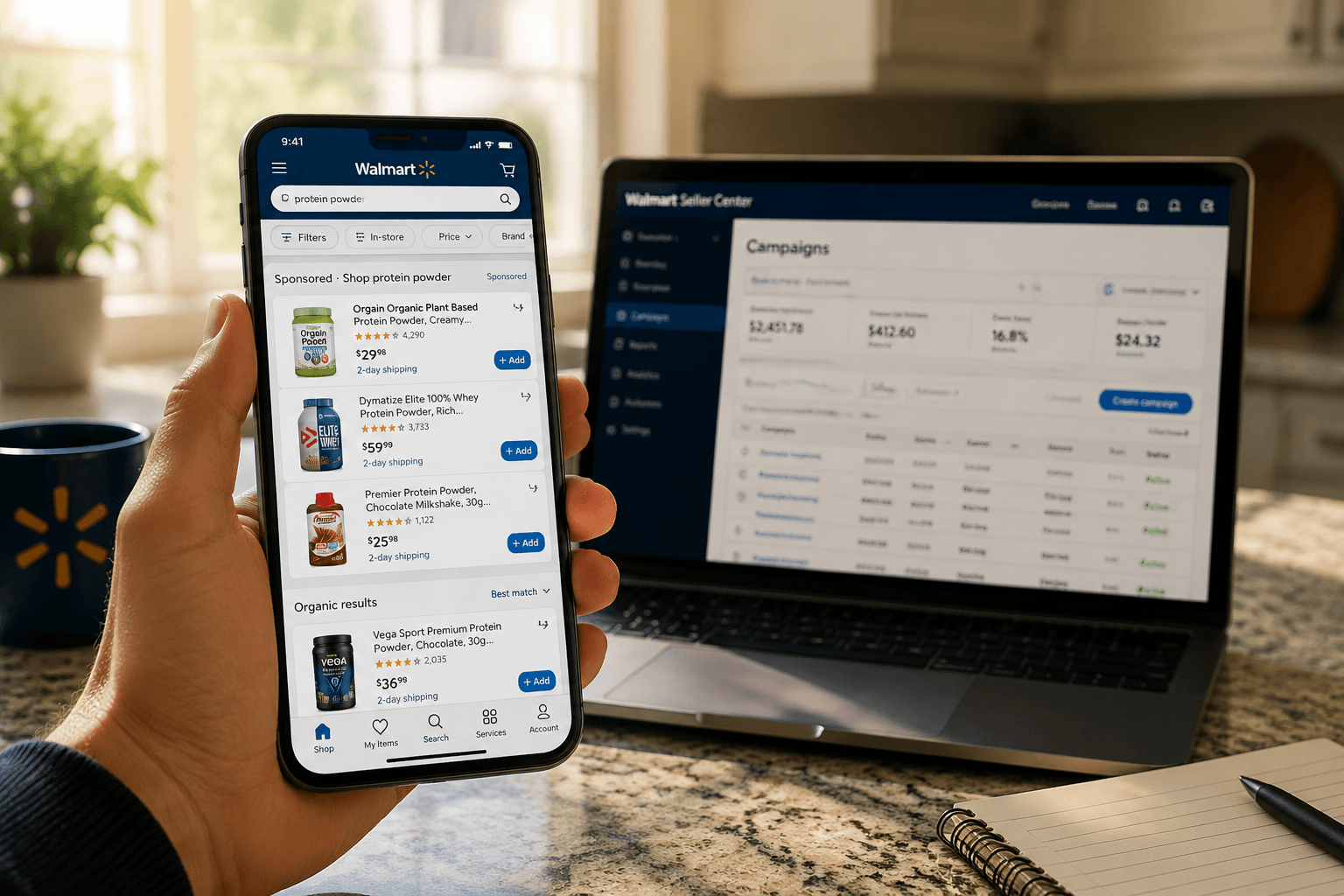
Walmart Sponsored Products is the highest-leverage Connect format for most brands. It places ads in search results and on product pages, and it's where the majority of Connect spend should be concentrated before activating any upper-funnel format. The mechanics are straightforward; the discipline required to run them correctly is not.
Campaign Structure
Exact-match campaigns built from Walmart-native keyword research should anchor the account. Phrase match can supplement once exact-match performance is established — but phrase match on Walmart behaves more conservatively than on Amazon, so don't expect it to drive the same discovery volume. Build the foundation on exact, expand deliberately.
Separate campaigns by match type and by product line. Mixing hero SKUs with long-tail items in the same campaign obscures performance data and prevents clean bid management. When a campaign contains both a top-velocity item and a low-review SKU, budget flows toward the item with stronger listing signals — usually the hero SKU — and the data you need to evaluate the long-tail item never accumulates. Clean segmentation is the prerequisite for clean optimization.
Item Eligibility — The Hard Constraint
Items without a buy box, below Walmart's seller rating threshold, or out of stock are ineligible to serve ads. This isn't a soft signal — it's a hard gate. Auditing every SKU for buy box ownership, review count, rating, and in-stock status before activating spend is not optional.
WFS items get the 2-day shipping badge and a structural advantage in both organic ranking and ad quality score. For most enterprise brands, activating WFS before scaling Connect spend is the right sequence — the badge improves conversion rate on the PDP, which improves the efficiency of every ad dollar you spend driving traffic to it.
Bid Management
Walmart Connect offers manual CPC and automated bidding. For enterprise brands with enough SKU history, manual CPC gives the control needed to manage placement efficiency by keyword. Automated bidding suits accounts with thin data or as a test layer alongside manual campaigns — not as the primary bid strategy for a brand serious about profitability.
Set bid floors by item margin, not by category average. A SKU with strong gross margin can sustain a higher CPC than a thin-margin SKU at the same conversion rate. Blended account bids obscure this and inflate spend on low-margin items. Know your margin by SKU before you set a single bid.
Placement-level performance varies meaningfully between search in-grid, buy box, and home page placements. Pull placement reports regularly and cut bids on placements where the conversion rate doesn't justify the premium. Walmart Connect's reporting interface is less granular than Amazon's, so clean campaign naming and disciplined placement analysis are the primary levers for optimization without custom tooling.
Sponsored Brands: When and How to Activate the Format

Sponsored Brands places a banner unit at the top of search results. It's a brand-awareness and category-ownership format — not a direct-response unit — and it should be funded after Sponsored Products is profitable. Activating Sponsored Brands before the foundation is working inflates spend without improving the metrics that matter.
The format requires Brand Registry enrollment and a minimum number of eligible items. Brands that haven't completed Walmart's brand registration process can't access it — a blocker we see in new account audits more often than it should, because the registration process has meaningful lead time and brands frequently underestimate it.
Creative execution matters more here than in Sponsored Products. The banner headline, hero image, and item selection are all variables. Weak creative with strong bids still underperforms against well-built units with moderate bids. Asset quality compounds — a banner that doesn't communicate brand positioning in the first half-second is a wasted impression regardless of bid level. The Sightline AI Engine produces Walmart-native banner creative on a weekly cadence, which matters because Walmart's image specs and creative requirements differ from Amazon's, and repurposed Amazon assets frequently fail Walmart's spec review or simply don't perform in the format.
Category Defense
If a competitor is running Sponsored Brands against your brand keywords, activating your own campaign on those terms is the fastest way to reclaim top-of-page real estate. This is the clearest ROI case for the format — not discovery, but defense. Brand keyword protection on Walmart is underinvested by most brands, which means the competitive threat often sits there uncontested.
Sponsored Brands should represent a smaller share of Connect spend than Sponsored Products for most brands. The exception is high-consideration categories where brand trust drives conversion and top-of-page visibility compounds organic ranking — in those categories, the format punches above its direct-response weight.
Search Brand Amplifier: The Most Underused Format in Walmart Connect
Search Brand Amplifier is the format most consistently missing from Walmart accounts that come to us from Amazon-first agencies.
SBA places a logo, headline, and product carousel above organic search results on branded and category queries. It's structurally different from Sponsored Brands in both placement and intent — SBA sits above everything else on the page, including Sponsored Brands units, which makes it the most prominent ad position available on Walmart search. And most brands aren't running it.
The primary use case is brand-name query defense. If a shopper types your brand name into Walmart's search bar and you're not running SBA, a competitor's Sponsored Products or Sponsored Brands ad can appear above your organic results. That's a direct threat to brand equity — and it costs nothing to fix once SBA is active.
SBA requires a Walmart Brand Portal account and category approval. The setup process takes longer than most brands expect, and the creative specs are distinct from Sponsored Brands: the logo lockup, headline character limits, and carousel item count each have requirements that need native creative, not repurposed Amazon A+ assets. Plan for the lead time and build the creative correctly. A half-built SBA unit is worse than no unit at all — it signals brand inattention at the most visible position on the page.
Measurement: SBA impressions and clicks are reported in Walmart Connect, but downstream conversion attribution follows Walmart's standard 30-day click window. Align your reporting cadence to that window before drawing conclusions from early data. Early reads on SBA performance are almost always misleading because the attribution window hasn't closed.
In our experience managing Walmart accounts across CPG categories, SBA is the format most often missing from accounts that came to us from Amazon-first agencies. It gets treated as optional when it's the brand's primary defensive position on Walmart search.
Bidding Strategy for Enterprise Brands: What Actually Works
Start with manual CPC on exact-match campaigns. Walmart's automated bidding lacks the data depth of Amazon's smart bidding in most categories, and manual control lets you establish a performance baseline before handing the auction to an algorithm that doesn't have enough signal to optimize reliably.
Dayparting
Dayparting is available in Walmart Connect and underused. For categories with clear purchase-time patterns — morning consumables, weekend household goods, seasonal items — reducing bids during low-conversion windows cuts wasted spend without sacrificing reach during peak hours. Most brands running ported Amazon campaigns never touch this lever because they're not thinking about Walmart's shopper behavior as distinct from Amazon's.
It is distinct.
Negative Keywords
Negative keyword management is critical and frequently neglected. Walmart's match type behavior means irrelevant queries can drain spend in auto and broad campaigns faster than most brands expect. Build a negative keyword list from the first week of auto campaign data and update it weekly. Don't wait for a monthly review cycle — the waste accumulates faster than that.
Budget Pacing
Walmart Connect doesn't have the same sophisticated daily budget pacing as Amazon. Budgets can exhaust early in the day in higher-competition categories, leaving afternoon and evening impressions unfilled. Monitor pacing daily in the early weeks of a campaign and adjust budgets or bid levels to smooth delivery. An account that runs out of budget by noon is effectively invisible for half the shopping day.
The Margin-First Framework
- High margin, strong listing, buy box owned — Bid Approach: Aggressive manual CPC, test higher placements. Notes: Can absorb higher CPC; prioritize share.
- Mid margin, solid listing — Bid Approach: Conservative manual CPC, exact-match only. Notes: Build velocity before expanding bids.
- Lower margin — Bid Approach: Minimal spend until margin improves. Notes: PPC rarely pencils at thin margins.
- New SKU, few reviews — Bid Approach: Auto campaign (diagnostic only) + low-bid exact. Notes: Build data; don't scale until listing is ready.
The pattern we see repeat across enterprise client accounts: brands overspend on auto campaigns and underspend on exact-match manual campaigns. The auction rewards the opposite.
The Listing Foundation That Makes or Breaks Walmart PPC
Walmart Connect spend is wasted if the listing isn't built for Walmart's algorithm first.
The ad drives the click. But the algorithm's quality score — and the shopper's conversion decision — both depend on listing completeness and trust signals that Amazon listings don't automatically satisfy. A brand that activates Connect spend on listings built for Amazon is paying to drive traffic to a page that Walmart's own system is deprioritizing.
Title Structure
The first 50–75 characters of a Walmart item title carry the most weight in the search index. Brand name, primary keyword, and key differentiator need to front-load the title — not trail after filler words or secondary descriptors. This is different from Amazon, where keyword placement across the full title matters more evenly. On Walmart, the front of the title is the signal.
Short Description and Key Features
These are the primary keyword fields Walmart's algorithm reads for relevance. They need exact-match target keywords written in plain, literal language — not the benefit-forward copy that works on Amazon A+ content. "Chocolate protein powder 2lb bag" belongs in the description. "Fuel your gains with our premium blend" does not help Walmart's index match your item to a shopper query.
Rich Media and Imagery
Rich media and 360-degree imagery improve conversion rate on Walmart PDPs. Walmart's image requirements differ from Amazon's, and repurposed Amazon hero images frequently fail Walmart's spec review or render poorly in Walmart's image viewer. Native Walmart creative — built to Walmart's specs, optimized for Walmart's PDP layout — outperforms ported assets reliably. The Sightline AI Engine produces Walmart-native rich content on a weekly cadence, which matters when you're managing creative refresh across a full catalog and can't afford a six-week turnaround from a traditional creative vendor.
Reviews and Ratings
Review count and rating are both a listing trust signal and an ad eligibility factor. Walmart has no Vine equivalent at scale. Brands that wait for organic reviews to accumulate are waiting for a signal they need before PPC can perform — and organic review velocity on Walmart is slower than Amazon for most new listings. LSD built a proprietary TOS-compliant review generation program specifically for Walmart to close this gap. It's not optional infrastructure; it's a prerequisite for the ad spend to work.
Item Attributes
Item attributes and category taxonomy must be complete and accurate. Walmart's faceted search filters depend on structured attributes — size, flavor, count, material, use case — and items with incomplete attributes don't surface in filtered results even when ads are running. A shopper who filters for "30-serving protein powder" won't see your item if the serving count attribute isn't populated. The ad impression never happens.
How to Structure a Walmart Connect Account That Scales

Account architecture is the difference between a Walmart Connect program that compounds and one that flatlines at the same spend level month after month.
Campaign Architecture
Separate campaigns by match type and by product line. Exact, phrase, and auto campaigns should be distinct — not layered into the same campaign with mixed match types. Hero SKUs should have their own campaigns, separate from mid-tier and long-tail items. This isn't bureaucratic tidiness; it's the structural requirement for clean bid management and readable performance data.
Campaign naming convention matters more on Walmart than most brands expect. Walmart's reporting interface is less granular than Amazon's, so clean naming is the primary way to segment performance by product group, match type, and placement without building custom reporting infrastructure. A naming convention established at account launch saves hours of analysis time every month.
Hero SKU Prioritization
Identify the two to four items with the strongest listing quality scores, buy box ownership, and review counts. Concentrate initial Connect spend there. Building sales velocity on hero SKUs before expanding to the full catalog is the sequence that compounds — strong hero SKU performance improves overall account health signals, which benefits the catalog when you expand.
Don't spread budget across 40 SKUs in month one. It's a fast way to generate thin data on everything and actionable data on nothing.
Keyword Research — Walmart-Native Only
Keyword research for Walmart should pull from Walmart's own autocomplete, Walmart search term reports (after auto campaigns have run for two to four weeks), and category-level competitor title analysis. Not from Amazon Keyword Scout, Helium 10 exports, or any tool that reflects Amazon's index. The two indexes are different. Tools built for Amazon reflect Amazon's semantic expansion behavior — which doesn't transfer to Walmart's literal matching.
Attribution Window Alignment
Walmart Connect uses a 30-day click attribution window by default. Amazon's default is 7-day click. Comparing Walmart ROAS directly to Amazon ROAS without adjusting for the window difference produces misleading conclusions — Walmart's number will look stronger than it is on a same-window basis. Set your reporting cadence and ROAS targets to Walmart's 30-day window, and document the difference when presenting to stakeholders who are used to Amazon benchmarks.
Incrementality Testing
Walmart's measurement tools are less mature than Amazon's. Running geo-based holdout tests or pausing campaigns on secondary SKUs for two-week windows gives a directional read on true incrementality before scaling spend. It's imperfect, but it's more defensible than assuming every attributed conversion is incremental — which, across a 30-day attribution window, it often isn't.
The Real Walmart Connect Opportunity in 2026 — and What Brands Get Wrong About It
Walmart Connect is not a cheaper Amazon.
It's a different auction with different trust mechanics, a different shopper intent profile, and a different creative environment. Brands that treat it as a discount channel get discount results. Brands that rebuild for it natively are competing in a less saturated auction with a shopper base that's large, growing, and increasingly comfortable purchasing across categories beyond grocery.
As of 2026, Walmart's online shopper base spans grocery, general merchandise, health, and consumables at meaningful scale. The Connect auction is less saturated than Amazon in most CPG categories. WFS adoption has improved delivery reliability enough that the 2-day badge is now a real conversion signal, not just a nice-to-have. The infrastructure for profitable PPC exists — but only if the listing foundation is built correctly first.
The brands winning on Walmart Connect right now are not the biggest spenders. They're the ones that rebuilt listings natively, activated WFS, generated reviews through a compliant program, and structured campaigns around exact-match keyword discipline before scaling budget. Spend follows performance, not the other way around.
The managed-service advantage over software-only vendors is real here. Tools can automate bids and flag anomalies. They can't rebuild a listing, run a TOS-compliant review generation program, or tell you that your title's first 60 characters are losing to a competitor whose listing was built by someone who actually understands Walmart's index. That's the operator gap — and it determines whether your Connect spend is profitable or not.
The Sequence That Works
The Laser Focused Blueprint applied to Walmart runs in this order:
- Walmart-native SEO and listing rebuild — title structure, short description, key features, attributes, rich media, all built for Walmart's literal index, not ported from Amazon.
- Review generation — through a TOS-compliant program, because organic review velocity on Walmart is too slow to wait out.
- [WFS activation](https://www.walmart.com/wfs) — for the 2-day badge, the organic ranking advantage, and the buy box stability.
- Sponsored Products on hero SKUs — exact-match campaigns, manual CPC, margin-aware bids, clean campaign architecture.
- Sponsored Brands — once Sponsored Products is profitable and brand registration is complete.
- Search Brand Amplifier — for brand-name query defense, activated as soon as Brand Portal access is established.
Skipping steps one through three and jumping straight to step four is why most brands stall. The PPC spend is real. The foundation isn't there to convert it.
If you're running Walmart Connect campaigns that were built by an Amazon-first agency or ported from your Amazon account without a native rebuild, the audit will show it. The fix is structural — not a bid adjustment.
In our experience managing $450M+ in client ad spend across enterprise CPG brands, the Walmart accounts that perform are the ones where someone made the decision to treat Walmart as its own channel from the start. That decision usually comes after one quarter of flat performance on ported campaigns. It doesn't have to.
Frequently Asked Questions
How much should a CPG brand realistically budget for Walmart Connect in year one?
There's no universal floor, but brands that treat Walmart Connect as an afterthought — allocating whatever's left after Amazon — consistently underinvest during the period when listing trust signals and keyword data are still being built. A more useful framing: size the budget around the SKU count you're actively supporting, the auction depth in your category, and the margin structure of your Walmart assortment, not as a percentage of your Amazon spend. Year one is a data-building exercise as much as a revenue exercise, and underfunding it means the algorithm never accumulates the in-stock and relevance signals that compound into efficient CPCs later.
Can we manage Walmart Connect in-house if we already have a strong Amazon advertising team?
Amazon expertise transfers less than most teams expect — the keyword research methodology, match-type logic, auto campaign strategy, and listing optimization approach are all materially different on Walmart. In-house teams that run Walmart as a side project of an Amazon program almost always port Amazon campaign structures and then misattribute flat performance to low platform volume rather than structural campaign errors. If you have the headcount to dedicate a specialist who learns Walmart's algorithm natively and isn't also managing Amazon, in-house is viable; if that specialist is splitting time, the efficiency drag compounds quickly.
What happens to Walmart Connect performance if our listings have fewer than 50 reviews?
Walmart's algorithm weights listing trust signals — including review count and rating — as ranking inputs, which means paid placements on thin-review listings face a conversion rate ceiling that no amount of bid adjustment can fix. Running Sponsored Products spend into a listing with minimal social proof typically produces poor ROAS not because the targeting is wrong but because the page itself doesn't convert at the rate the auction requires to be efficient. The right sequence is to build review velocity first, then scale paid spend — Walmart has no native equivalent to Amazon Vine, so brands need a TOS-compliant review generation program in place before treating Connect as a growth channel.
Should we use Walmart's 30-day attribution window to compare Walmart Connect ROAS directly against Amazon's 7-day ROAS?
No — comparing Walmart's 30-day click attribution against Amazon's 7-day default inflates Walmart ROAS in a way that makes the channels look more equivalent than they are, and deflates it when you try to normalize. The right approach is to hold each platform's ROAS to its own attribution window consistently, track total Walmart revenue trends alongside ad spend over time, and use blended metrics (total sales, organic lift, market share within category) as the cross-platform comparison layer rather than ROAS alone.
Is Walmart Connect worth prioritizing for a brand that does most of its volume through Walmart 1P (Supplier/Retail Link) rather than 3P Marketplace?
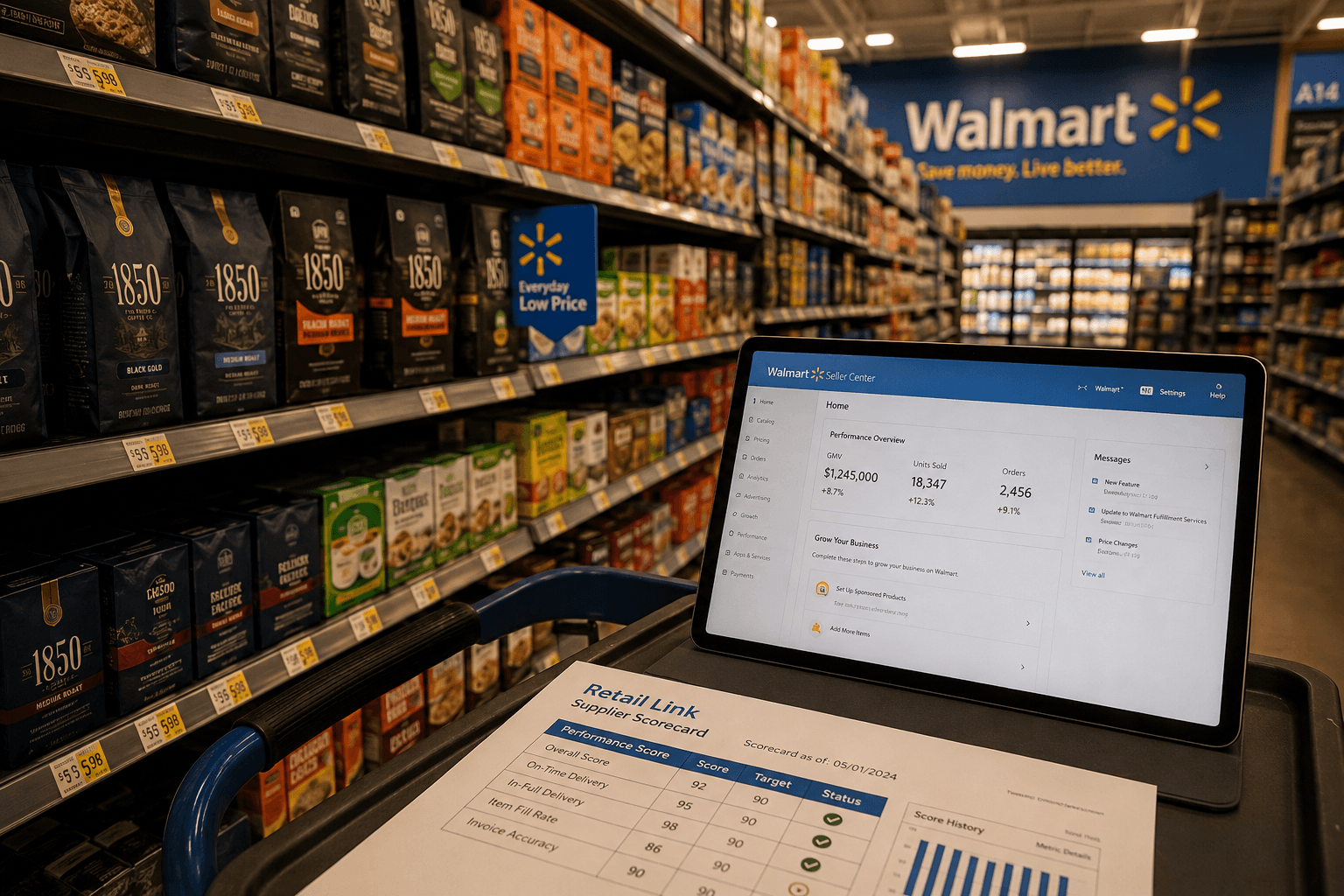
Walmart Connect via Seller Central is built for 3P sellers, and the targeting, campaign management, and optimization levers available to 1P suppliers through the DSP and managed-service path are structurally different — and generally less flexible. If your Walmart business is primarily 1P, the Connect PPC playbook described for 3P doesn't map directly; you're operating through a different commercial relationship with different inventory and content controls, and the campaign architecture needs to reflect that. Brands running a hybrid 1P/3P model on Walmart face the most complexity and typically benefit most from a team that understands both sides of the Retail Link and Seller Center simultaneously.
How do Walmart Connect creative requirements differ from Amazon, and does that affect how fast we can launch campaigns?
Walmart's creative specs, content policies, and image requirements differ enough from Amazon's that assets built for Amazon PDPs and Sponsored Brands ads frequently require meaningful rework before they're eligible — or effective — on Walmart. Beyond compliance, Walmart shoppers respond to different visual cues: value framing, pack-size clarity, and in-context lifestyle imagery tend to outperform the premium aesthetic that works on Amazon in many CPG categories. Brands that try to launch Walmart campaigns using Amazon creative as-is typically see lower click-through rates on placements where the creative doesn't match shopper expectations, which compounds the algorithm trust-signal problem before the campaign ever gets traction.